Skip to content
Smart Lead Tech
Home
Services
Our work
Saudi Arabia
About us
Blog
Contact us
🇸🇦العربيةContact now
Smart Lead Tech

Smart software solutions

Follow us

Company

  • About us
  • Our work
  • Our services
  • Saudi Arabia
  • Restaurant POS
  • Contact us
  • Book a call

Quick links

  • Blogs
  • Pricing
  • Refund policy
  • Privacy policy
  • Terms and conditions
  • Data deletion

Contact us

  • Egypt — Head Office

    Office 6, Bldg 23, Makkah Al-Mukarramah St., Omraneya, Giza 3540203, Egypt
  • Saudi Arabia — Branch

    Bldg 2646, Secondary 123, Street 7697, Ishbiliyah Dist., Jubail 35416, Kingdom of Saudi Arabia
  • Email address

    help@smartleadtech.com
  • Phone number 🇪🇬

    +20 102 201 4671
  • Phone number 🇸🇦

    +966 53 044 7112

© 2026 Smart Lead Tech. All rights reserved.

  • Smart Lead Tech Information Technology LLC·Commercial Register ⁦61239⁩·Tax ID ⁦774-391-316⁩

  • Smart Lead Tech Software Establishment·CR ⁦7054902585⁩·VAT

Computer vision outside the lab: two stories from the road and the eye clinic

Models look dazzling in the slide deck. The truth shows up at noon on a dusty highway, or in a clinic that sees eighty patients a day. These are two stories about the gap between “98% on the test set” and “actually works…

05/19/2026 — 9 min read

A retinal scan next to a traffic-camera frame with detection boxes

Models look dazzling in the slide deck. The truth shows up at noon on a dusty highway, or in a clinic that sees eighty patients a day. These are two stories about the gap between “98% on the test set” and “actually works”.

Story one: Darb — AI traffic incidents

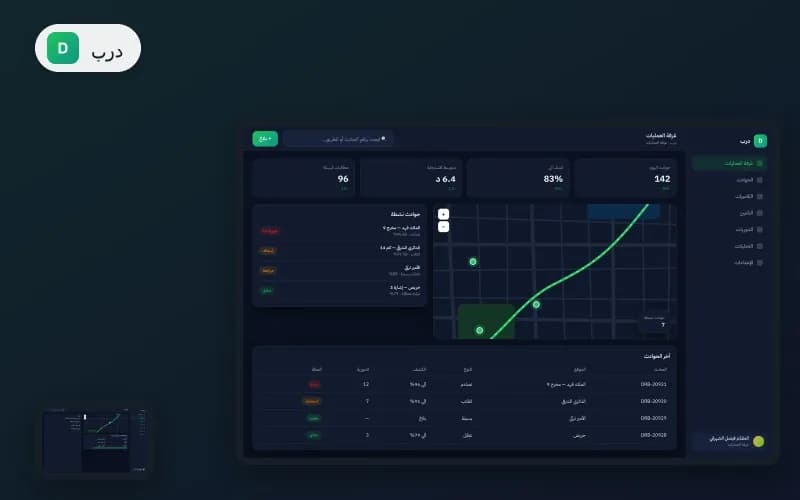
Darb is a traffic-incident management system: cameras, detection models, and tight integration with insurers. The first problem was not detection, it was dust. A dirty lens turns a truck into a shadow, and a model trained on clean images collapses. The fix: a frame-quality assessment stage before detection, and an automatic maintenance alert when quality drops for three consecutive days.

The second problem was human: the insurer’s claims handler does not trust a “black box”. So every incident is exported with the original frames, the detection boxes, the confidence score, and a “needs review” decision when confidence falls below a threshold. Trust did not come from higher accuracy; it came from showing the evidence.

Story two: Diabetes Vision Detector — retinopathy

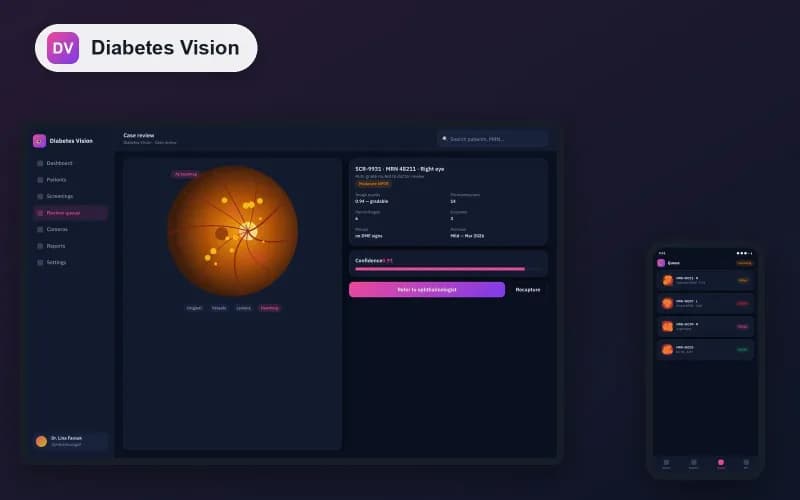
Screening diabetic retinopathy from fundus images is a task the model masters on public datasets. In the real clinic the camera, the lighting, and the share of “ungradable” images were different. The first production month had a 19% rejection rate — the model refusing to judge a poor image. It looked like failure; it was actually the most important feature.

A medical model that says “I cannot judge” is better than one that is confidently wrong. We defined rejection as an official outcome with its own path.

What we did: training on the clinic’s own images (with consent and anonymisation), and visual guidance for the technician at capture time (“retake — light reflection”). Rejection dropped to 6%, and “needs a doctor” remained a respected path.

A short third story: Smart Wear

Smart Wear fuses wearable hardware with AI for authentication. Same lesson in different clothes: biometric signals shift with heat and fatigue, and a model that does not know its limits becomes either annoying (rejecting the owner) or dangerous (accepting someone else). We built “grey zones” that ask for a second factor instead of a hard verdict.

What the three stories share

  • Input quality before intelligence: measure image/signal quality and decline politely.
  • Evidence with the decision: frame, box, confidence, reason.
  • A path for grey cases: human review, second factor, or recapture.
  • Train on data from the actual site: no public dataset looks like your cameras.

Computer vision in the field is not model science; it is operations science. The models that work are the ones designed to admit what they cannot see.
Share

Projects related to this article

  • AI SystemsPython

    Darb — AI Traffic-Incident Management System

    A smart system that manages and processes traffic incidents using ML, computer vision, and tight insurance integrations.

    Show more
    Darb — AI-driven traffic-incident management
  • AI SystemsPython

    Diabetes Vision Detector — AI Diabetic Retinopathy Screening

    An AI system that screens diabetic retinopathy via fundus-image analysis with clinical-grade accuracy.

    Show more
    Diabetes Vision Detector — AI fundus analysis
  • Real EstateLaravel

    Real Estates Matcher — AI-Powered Property Matching

    A smart real-estate platform that matches demand and supply using AI and data analytics.

    Show more
    Real Estates Matcher — smart demand-supply matching

Related Blogs

  • A nurse using a tablet app beside a patient at home

    Before any smart feature in a health app: the six guardrails we never negotiate

    We have built a range of health platforms: Reayah for home care, Women Health for holistic wellness, PharmaStore as an online pharmacy, and Qaweny for coaching and nutrition. On every one we were asked for “an AI feature…

    04/21/2026 — 8 min read

  • An Arabic invoice next to a field-extraction screen showing confidence scores

    343 pages and 99.42%: what building SLT OCR taught us about Arabic documents

    When we started SLT OCR we thought the problem was “reading Arabic letters”. After a year of invoices, purchase orders, ID cards and KYC packs, it turned out reading was the easy part. This is an honest post-mortem of wh…

    09/05/2026 — 11 min read

  • A phone camera pointed at a street while an AI assistant narrates what it sees

    Project Astra and the assistant that never closes: what the “camera that understands” means for your apps

    Imagine pointing your phone camera at a salad vending machine and hearing: “This machine accepts Apple Pay, and the lowest-calorie option is the third from the left.” That is not fantasy; it is what Google’s Project Astr…

    07/14/2026 — 7 min read